
News for Normies: An American Airman Rescued in Iran and More
April 6, 2026
Hi, and welcome to this week’s edition of News for Normies!
If you’re new here, this is what you’ll find in News for Normies, the serious part of this otherwise-lighthearted space.
News for Normies comes every Monday and is a post on three important news stories, served up with context, insight and some things to follow in the coming week.
Who are you? A normal person who has a whole life to live and not a lot of time to read or watch news.
What is this? Your go-to blog post that highlights a few big stories to keep you a little more informed in an ever-saturated news world.
So if you want to know what’s happening in the world but don’t have the time to monitor the headlines, you’re in the right place.
In today’s edition, let’s discuss: leaders pull out all the stops to rescue an American airman whose jet was downed in Iran; it’s been one year since “Liberation Day” with tariffs, and your wallet is feeling it; and an update on where the midterms actually stand.
Story 1: An American Airman Rescued in Iran.
“WE GOT HIM!” were the words President Trump posted on Truth Social Easter Sunday morning, announcing the rescue of an American fighter pilot whose jet was downed this weekend in Iran.
In the same message, the President added, in part, “This brave Warrior was behind enemy lines in the treacherous mountains of Iran, being hunted down by our enemies, who were getting closer and closer by the hour, but was never truly alone because his Commander in Chief, Secretary of War, Chairman of the Joint Chiefs of Staff, and fellow Warfighters were monitoring his location 24 hours a day.”
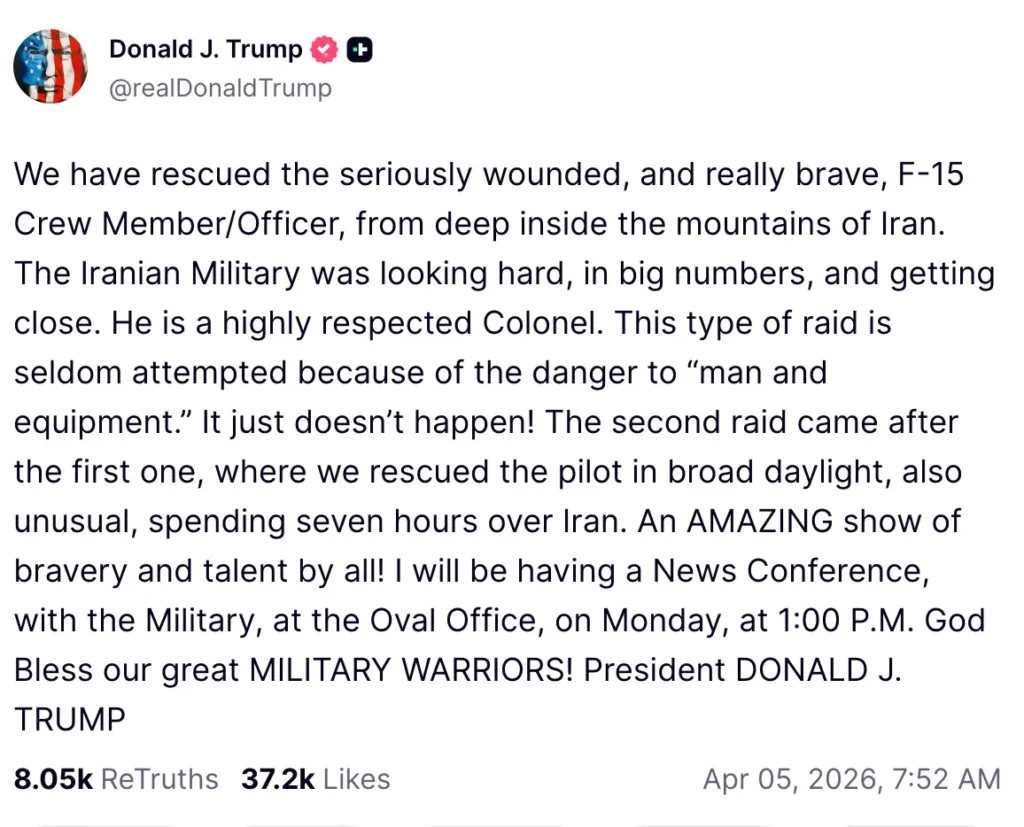
The F-15E airman was hiding in the mountains, even climbing a 7,000-foot ridge to evade capture, before American troops swept in to rescue him.
Context and Background
On Friday, an American F-15E Strike Eagle was shot down over southwestern Iran, making it the first U.S. combat aircraft downed by enemy fire since the war began on February 28.
Right after the crash, Iran’s state broadcaster aired a statement calling on residents to capture the “enemy’s pilot or pilots” and turn them over alive to security forces for a reward.
How Did the Rescue Happen?
It was, by almost any measure, an extraordinary operation. The CIA played a central role, first launching a deliberate deception campaign inside Iran, spreading word that U.S. forces had already located the airman and were moving him on the ground.
While Iranian forces were confused and searching the wrong area as a result of that message, the CIA used what a senior administration official described as “unique, exquisite capabilities” to track the crew member to a mountain crevice in a southwestern province of Iran. Once his precise location was confirmed, the CIA shared it directly with the Pentagon and the White House, and Trump ordered an immediate rescue mission.
The operation involved dozens of special forces personnel and several dozen warplanes and helicopters, The airman—who used his mandatory Survival, Evasion, Resistance, and Escape training to stay hidden for more than a day—sustained injuries but, according to Trump, “will be just fine.” He was flown to Kuwait for treatment.
Meanwhile, Iran’s military claims it destroyed two U.S. Black Hawk helicopters and a C-130 transport aircraft during the operation. A U.S. regional intelligence official has a different explanation, saying the U.S. military itself blew up two transport planes after they suffered a mechanical malfunction, but not as a result of Iranian fire.
Israeli Prime Minister Benjamin Netanyahu called it an “incredible rescue” and said it reinforced the principle that “no one is left behind.”
What Does This Mean for U.S. Claims of “Air Dominance?”
The White House and Pentagon had been publicly touting what they called complete control of Iranian airspace. Defense Secretary Pete Hegseth said as recently as Wednesday that the U.S. had achieved “total air dominance” over Iran.
While the shootdown seems to have complicated that picture, military analysts are careful to draw a distinction. As one former Air Force lieutenant general explained, air superiority doesn’t mean invulnerability; it means the ability to operate where and when you choose without prohibitive interference.
And the way Iran operates has a lot to do with how complicated these missions are. Iran reportedly keeps significant portions of its air defense systems hidden in underground tunnels and bunkers, and after strikes, they rapidly dig them out, returning them to operation within hours. (Iran’s mobile systems can be moved and concealed precisely to avoid detection.)
In short: Iran is more degraded than it was five weeks ago, but it is not out of the fight.
What Else Happened This Week in the War?
The short answer is, quite a lot, and none of it points toward a quick resolution.
On Saturday, Israel struck a petrochemical complex in southwestern Iran, killing at least five people and injuring 170 more. Israeli Prime Minister Benjamin Netanyahu called the sites a “money machine” for the Iranian government, whose funds were pumped into terrorist activity worldwide.
A projectile also struck near a power plant in southern Iran, killing one security worker. The strike marks the fourth time that the plant—partially built, and operated by, Russia—has been targeted since the start of the war.
While the International Atomic Energy Agency (IAEA) says there was no reported increase in radiation levels, director Rafael Grossi said he was “deeply concerned” and emphasized that nuclear power plants must never be attacked. In a cautionary move, Russia’s state atomic energy company evacuated 198 workers from the facility on Saturday.
Iran is Still Fighting Back
Iran, meanwhile, is firing back, sending ballistic missiles at Israel on Saturday, wounding four people. The UAE intercepted 23 ballistic missiles and 56 drones from Iran in a single 24-hour period.
And Yemen’s Houthi militia, which had been mostly quiet since the war began, fired at least one missile at Israel, both of which were intercepted, marking their first known involvement in this conflict.
The cost of war
The cumulative human cost continues to rise. The Human Rights Activists News Agency has recorded at least 1,607 civilian deaths in Iran, including 244 children. Lebanon’s health ministry has counted at least 1,345 Lebanese killed since fighting between Israel and Hezbollah resumed. Thirteen U.S. service members have been killed.
In a New York Times Magazine piece published this week, two ordinary Iranians—one a government supporter, one an opposition protester—chronicled their experiences of the war in real time, offering a rare and deeply human window into life in Tehran during the fifth week of bombardment.
Where do things stand diplomatically, and what is Trump threatening now?
On Saturday morning, Trump posted on Truth Social that Iran had 48 hours to open the Strait of Hormuz or “all Hell will reign [sic] down on them”—his third iteration of a deadline on the strait, each of which has been delayed.
According to Axios, indirect negotiations have been underway through Pakistan, Egypt, and Turkey, led on the U.S. side by Vice President Vance, but so far, little progress has been made.
One source involved in the talks said Iran has rejected any proposal for a temporary ceasefire and is demanding a permanent end to the war with guarantees the U.S. won’t attack again—a bar the U.S. has not been willing to meet. Senator Lindsey Graham, after speaking with Trump on Saturday, said he was “completely convinced” the president would use “overwhelming military force” if Iran continues to impede the strait.
The Economic Cost and Benefit of This War
The long-short of what this war means for the U.S. economy is this: While there’s a short term cost to war, President Trump is looking nowhere but forward, and according to one economics commentator from the Wall Street Journal, whatever Trump’s intentions are, the war has actually put the U.S. in a relatively advantageous economic position, compared to its allies.
Why? The U.S. is a net energy exporter, while Europe and Asia depend heavily on Gulf oil. Trump has addressed the lack of support from EU allies in the Hormuz issue bluntly, saying in recent Truth Social post, “Go get your own oil!”
Politics aside, Trump is prosecuting this war as a self-interested actor and is using energy dominance as leverage—a departure from Presidents past who acted more as guardians of global energy stability.
What to Follow
- The 48-hour deadline: It expires today. Watch whether Trump follows through with strikes on Iranian power plants or power infrastructure, or delays again, and how Iran responds either way.
- Fallout (literal and otherwise) from the strike at the nuclear power plant: Four strikes have now impacted the facility. Watch the IAEA’s ongoing monitoring and whether any radiation risk develops. The consequences of a nuclear incident at this site would extend well beyond Iran’s borders.
- The Houthis: Their re-entry into the conflict this week raises the prospect of renewed disruption to Red Sea shipping lanes, which have been a critical alternative route since the Strait of Hormuz closure.
- The diplomatic back-channel: Can the Pakistan-led mediation produce any progress before Monday’s deadline? Will direct talks between the U.S. and Iran ever materialize?
Story 2: One Year of Tariffs. Here’s What They’ve Actually Done to Your Wallet.
It’s probably not a date marked on your calendar, but April 2 marked the one-year anniversary of “Liberation Day”—the moment President Trump walked into the White House Rose Garden and imposed sweeping tariffs on imports from nearly every country on Earth.
A year later, the picture is complicated, and while the White House says we’ve seen some upsides, prices for the average American don’t necessarily reflect success.
Context and Background
President Trump said April 2, 2025—self-proclaimed “Liberation Day”—would go down in history as “the day we began to make America wealthy again.” He promised that tariffs imposed on imports from other nations would cause jobs to come “roaring back,” cause consumer prices to fall, and bring back American manufacturing.
One year on, the Supreme Court has struck down most of those tariffs as unconstitutional, a 10% blanket tariff remains in place, and economists are largely in agreement that the bill has not been paid by foreign countries as much as by American businesses and consumers.
What Actually Happened to the Tariffs?
The story of the last year is one of constant whipsaw. Over the past year, the administration enacted more than 50 different trade policy changes—a pace so relentless that the Budget Lab at Yale built a dedicated daily tracker just to keep up.
The effective tariff rate started 2025 at around 2%, spiked to the highest level in a century after Liberation Day, peaking at 21%, and now sits at 11% following the Supreme Court’s February ruling that said Trump had essentially overstepped his authority in imposing broad tariffs.
The government may now be required to refund as much as $166 to $175 billion in tariffs to the businesses that paid them, but say they have to update their technology before doing so. Trump immediately used a separate statute to reimpose a 10% tariff for a temporary five-month period.
Who Actually Paid for the Tariffs?
Trump has consistently argued that foreign exporters would absorb the cost of his tariffs for the “privilege of access” to the American market, but that’s not what the numbers are showing is happening.
Economists at the Federal Reserve Bank of New York found that nearly 90% of the economic burden from the tariffs fell on U.S. businesses and consumers. Goldman Sachs put the figure at 82% as of October 2025, and projects that consumers alone will bear 67% of the cost by July of this year, meaning businesses, which initially absorbed much of the hit, are now passing it along. “A lot of our clients really didn’t want to pass the costs on,” one tariff consultant told CNN, “but now they’re really having to.”
The Tax Foundation estimates the average U.S. household will face a tax increase of around $600 in 2026 from the tariffs currently in place. Food prices rose 2.8% as a result of all 2025 tariff actions combined, with fresh produce up 4%, according to the Council on Foreign Relations.
And finally, Procter & Gamble, which makes many household staples, said it had to raise prices on 25% of its products due in part to a $1 billion annual tariff impact.
And economists warn that we may not have even felt the full yet. The Council on Foreign Relations notes there’s typically a twelve-to-eighteen month lag before tariff effects reach consumers, which means we could face highest prices between April and October of this year.
The President’s Side
The White House says that there’s more to this story.
In a recent press release they cited the following statistics:
- A narrowing trade deficit: President Trump says our trade good deficit has fallen by 24% from last year.
- The burden has shifted: The White House also disputes the claim that Americans are bearing the tariff cost, citing a study that says the opposite—that foreign producers are the ones bearing the burden.
- Wage gains: The White House also says private sector workers have seen a wage gain of $1400 on average, with “blue collar workers” seeing the most gains—averaging $1800 for manufacturing, $1900 for mining and logging wages, and $3000 for construction work.
Read more on the President’s POV here.
Does the Iran War Complicate All of This?
Yes, significantly. The war has sent global energy prices sharply higher; gas prices in the U.S. have risen 93 cents per gallon since the start of the conflict — adding an entirely separate inflationary layer on top of tariff-driven price increases. Fed Chair Jerome Powell acknowledged last month that inflation at 2.4% in February reflects pressure in the goods sector “boosted by the effects of tariffs,” and economists warn that the energy shock from the war could push it higher still. The two crises — tariffs and war — are now feeding each other in ways that are hitting consumers at the checkout line and the gas pump simultaneously.
What to Follow
- The tariff refunds: Customs officials are working to refund approximately $166 billion in tariffs ruled illegal by the Supreme Court, hoping to make progress by the end of this month. Watch whether that money actually flows back to businesses, and whether businesses pass those savings to consumers.
- Peak tariff pressure: Economists project the heaviest consumer price impact arriving between now and October. Grocery receipts and household goods costs will over the next few months are the clearest real-time indicator of whether those projections will be true.
- The 10% blanket tariff’s expiration: Trump reimposed a 10% tariff under a separate statute for five months following the Supreme Court ruling. When that window closes, what will happen? Will Congress act, or will Trump find another path?
- The war’s economic long tail: Goldman Sachs has suggested increased oil prices could persist into 2027. Will the Fed adjust rates accordingly?
Head to Substack for my breakdown of this week’s third story: With seven months until Election Day, the 2026 midterms are looming, and we may be seeing one of the more consequential elections in decades.
See you next week!